

Raising happy, well-behaved children does not mean that you have to be a control freak. The long term aim is to develop self- discipline and self-control in your child. This means allowing them to make mistakes and then guiding them. Discipline is not about punishment or pain, it’s about guiding, rewarding and encouraging good behaviour. Discipline should be something positive and not confused with punishment. Discipline is something that can be imposed on us from outside or it can come from within i.e. self-discipline. Naturally, a toddler cannot practice self-discipline yet, we as parents and teachers need to guide the toddler. Good discipline starts in the home and then prepares the child for a smooth transition into school. It will impress no one if a child’s academics is like a baby genius but his behaviour is like a baby tyrant. The word discipline in the dictionary means: ‘The practice of teaching or training.’ The word disciple in Latin means learner, someone who is ready to learn a set of rules or a code of behaviour. If we think of discipline in this way, it takes the fear of punishment out of the equation. As parents and teachers, we are here to teach our children right from wrong and that smart choices and bad choices either have positive or negative consequences. When the children go to big school they will be expected to sit still, listen and follow instructions, share and behave. At a preschool-age they are ready to start taking some responsibility for their own affairs, we can help this process by loosening the reins a bit, allowing them a little freedom of choice. This allows the child to feel the consequences of their own smart or bad choices. This is a learning opportunity we must afford them, within safe boundaries. Before the age of 2, our children do not purposefully behave deviously, aggressively or nastily. Their actions and behaviour just lack thought. They will need to be guided into what is acceptable behaviour. A lot of this will be taught through our own behaviour that we model for the children. Sometimes excessive strictness will result in a child who appears to be compliant on the surface, but underneath the surface is the potential for resentment and rebellion. Children raised in a military strict environment will only behave well while the threat of intimidation is present, once they get older, they rebel. These children often become teenagers who rebel by having crazy parties and boozing up while parents go away for the weekend. The threat is removed for that weekend. In this case, it’s clear to see that discipline was imposed on this child and the child has not mastered self-discipline. No matter what form of discipline you decide to practice, children will carry these practices into their adulthood and these attitudes will surface in their own parenting. A starting point: Communicate clearly: In order for discipline to be effective we need to be clear and let the toddler/ preschooler know exactly what is expected of them. Get down to their eye level, so they don’t feel intimidated and use your eyes and tone of voice to convey the seriousness of your message. Your tone should be firm and not intimidating. In this way, they have your undivided attention. Use simple phrases and not big words that they cannot understand. Keep it simple and short, so that there is no confusion around what is expected. Be consistent: Consistency is key. There needs to be only 1 set of rules and the child needs to know that the rules remain the same every day. Imagine if the speed limit on the roads were changed daily, without prior notice, you would be so confused and you wouldn’t know when you are following the rules or breaking them. This is how children feel when there is a lack of consistency. Both parents need to be on the same page as this also talks to consistency. Each parent cannot have a separate set of rules. Structure and routine: children thrive on routine, it makes them feel safe and secure. Building a routine supports your discipline efforts. It makes life easier for parents and toddlers. Don’t think that the toddler is bored by routine, it is really quite the opposite. Be positive: Discipline is most successful when delivered positively. Believe in your approach and deliver it gently, calmly, confidently and with love. Your confidence and belief in your ability to make it work transmits to the child. This does not mean you need to shout or be loud, it just means be confident and firm. Positive parents are powerful people. Points to remember: Don’t nit-pick. Choose your battles. Avoid escalation, rather distract or divert. Once an incident is dealt with, it’s finished, don’t revisit it. Avoid too much negativity i.e. overusing the word ‘NO’, or negative comments. Try and put a positive spin on the way you phrase things. It takes 2 to tango, if you step back and gain perspective and then approach the situation calmly, the situation will de- escalate. Even the most gifted toddler cannot fight with himself. Don’t take your toddlers’ behaviour personally. In conclusion, we must not forget that we are adults, our children have underdeveloped emotional intelligence and they take the lead from us. Young children want to be good and are happiest when they know what is expected from them. Be clear, keep it simple and be consistent.

Tantrums and other antics
Disciplining a toddler is a lot like juggling sticks of dynamite, you never know when it’s goingto go according to plan or when it’s going to blow up in your face.How do we remain calm as the toddler puts on an award winning theatrical performance onthe kitchen floor or even worse, the middle of the supermarket?Tantrums are one of the trademarks of a toddler and quite normal for this age. Toddlers areperceptive and smart and the tantrum is designed to elicit the most reaction that they can getfrom you.Once the tantrum starts, its length and intensity depends entirely upon the reaction thetoddler gets from you.Centre stage is a strong willed toddler, who cannot get what he desperately wants. It isprobably something that seems very important to him. He assesses the situation and seesthat you are not giving in and so he launches into a spectacular performance. Theperformance requires an audience and he will look over his shoulder to make sure you arewatching. The more you react, the more the tantrum escalates.Tantrums start around the first birthday and are regular occurrences throughout the toddleryears. Tantrums in the young toddler usually happens because they don’t know any better orthey feel hugely frustrated with not being able to communicate their wants and needscoherently.In older toddlers, the 3 to 4 year old age group, tantrums can be more intentional, used as away to specifically irritate mom and dad.While younger toddlers run out of steam quite quickly and the tantrum is short lived, theolder toddler can carry on for long periods and the tantrum can build in intensity. What to do:Many parents feel frustrated and helpless because no matter what they do, they cannotseem to reason with their toddler or stop the tantrum. Many parents feel embarrassed whenthe toddler throws tantrums in public, having to deal with the toddler and onlookers is notpleasant.The way you deal with the tantrum depends on the age of the child, where it is happeningand the reason for the tantrum.Before the age of 2, when there is not much thought or reason behind tantrums, it is best tojust divert the child. For example, the child is on the floor screaming, you could divert bysaying… ‘Look, I think that may be daddy, I heard a car, let’s go and look. When of cause it’snot daddy, but the child is now quiet and walking with you, you can say… ‘Oh dear it isn’tdaddy, he is still on his way, but let’s look at all the cars passing by, how many cars arethere, I see a blue car’… and so forth. It is different for a 3 year old. At this age they can use a tantrum just too openly defy theparent’s authority. This is not acceptable and must be dealt with firmly, using discipline todiffuse the tantrum.Techniques for calming a tantrum: Diversion – The first thing with any age is to divert their attention to something elsethey will find more interesting. Ignoring – Should diversion not work, walk away to another section of the roomwhere you can still keep an eye on the child, but do not make eye contact. Pretend tobe ignoring the child. You can sing, wash the dishes or fold laundry, just do not givethe child any attention until he calms down and approaches you calmly. Now youmay think this will never happen, however as soon as the toddler sees he is notgetting any reaction from you, he will in most cases stop and come to you for comfortand hugs. In this case forgive and forget, give him a hug and move on, do not praisehim for stopping as that may warrant another outburst. What he did was wrong, youwant to show the child that you love him and forgive him, but gushing at this pointsends the wrong message. Time out- If the above does not work and your toddler is kicking you, screaming andgoing crazy, move to time out. Before you lose your grip, it’s time to put some spacebetween yourself and the toddler. Gently lift him up and take him to his room orwherever time out is, be serious, not angry or aggressive and tell the toddler that heis to stay in his room and he can only come out once he has calmed down. Thenleave the room swiftly and wait. Once the fireworks are done and the child comes out, forgive and forget, rememberits futile reasoning with a toddler.When out in the supermarket, go down to the child’s level and tell them that you want themto stop this behavior now, or you will leave immediately and he won’t have the privilege ofcoming to the shops with you again. In severe cases you may actually need to leave yourtrolley and take the child home immediately. If you do this once, the child will know that youmean business and future outings will be easier.The basic steps that parents can follow include diversion, selective deafness, selectiveblindness and time out. It is very important to remember that the biggest mistake you canmake is to give in to the child’s manipulation and dramatic antics. You will end up reinforcingthe very behavior you want to change.All of this must be executed calmly with love and gentleness. We must not forget thattoddlers are still learning to control their behaviours and we are the adults, we need to modelthe correct behaviour for them.The good news is that tantrums usually stop at around 4 years old, it does not last forever.
Cognitive Development
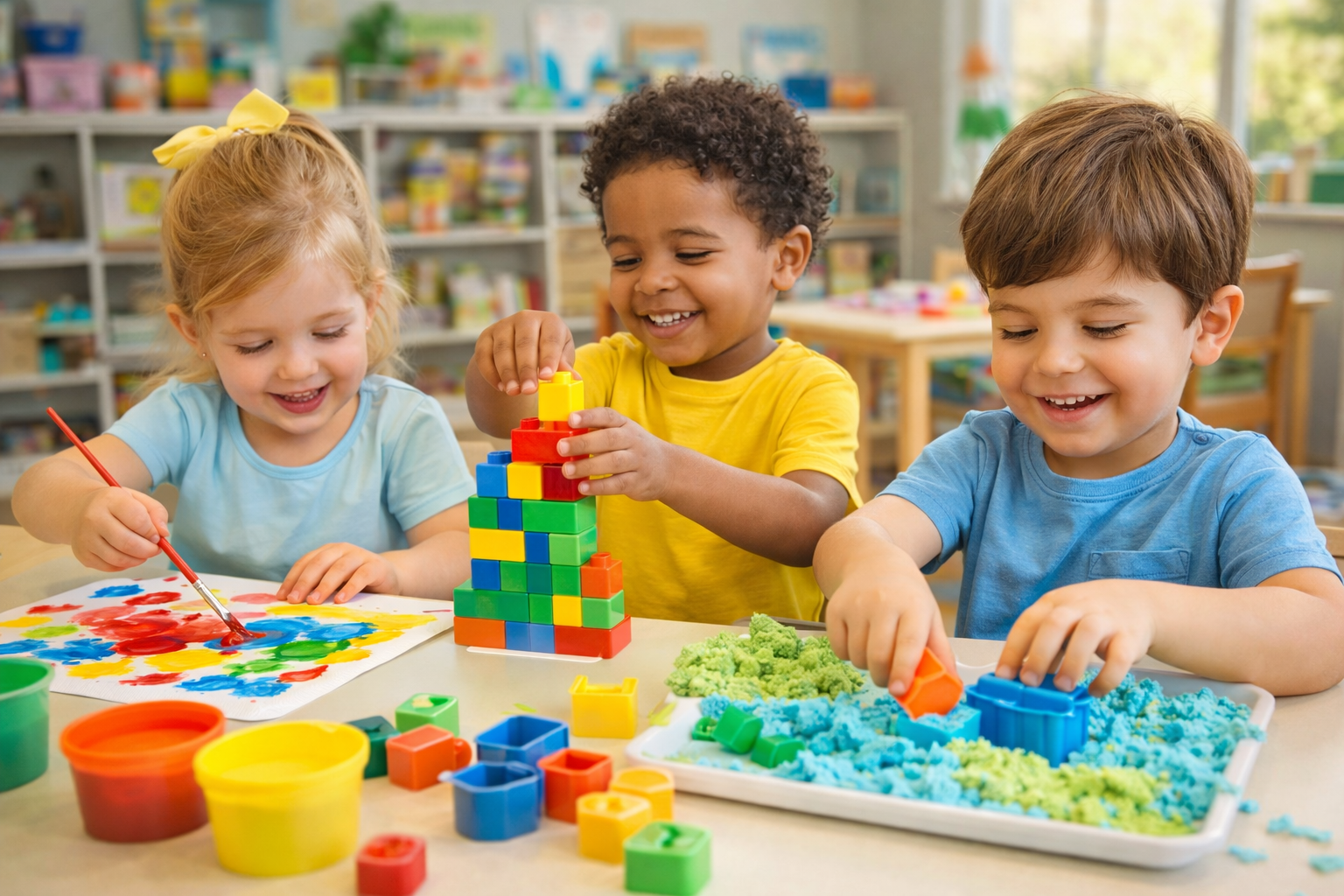
The early years are a critical time for your child’s cognitive development, which is how their thinking and understanding of the world grows. This rapid development begins in the toddler years, with skills like problem-solving, memory, and attention blossoming. At Cedar Crest Nursery school, we understand the importance of fostering cognitive development through play. Playtime isn’t just about fun (although that’s important too!), it’s a powerful tool for learning and growth! The Power of Play: Examples of Play-Based Learning: Beyond Cognitive Benefits: Play also promotes physical development through activities like climbing and outdoor play. In addition, threading beads and tearing/pasting activities enhance fine motor skills. Our Approach: Our experienced educators seamlessly integrate essential knowledge into playtime activities. For example, sorting toys might involve separating yellow objects during a focus on the colour yellow. For older children, we might introduce matching card games or dominoes to reinforce specific learning objectives. The Takeaway: Play is a cornerstone of early learning. When you see your child’s knowledge expanding, remember – they’ve likely been “playing hard” at nursery school! We provide a nurturing environment that fosters cognitive development, social skills, and a love for learning through engaging, play-based activities.
Sub-conscious learning
We have often heard the saying, ‘like father like son’ or ‘like mother like daughter’, what does this mean? To sum it up, it’s nothing too mysterious, children ‘learn what they live’ and then they ‘live what they learn’. The brain is our most powerful resource, storing information and recalling it automatically and uncritically. We all know about the left and right brain, there is a lot written on this, however, we are going to take a look at the top and bottom brain. If we were to draw a line separating the top from the bottom brain, we can start to understand how and why children live out in their adult life, what they learnt as children. Let’s look at the top and bottom brain. The top is your conscious mind, the thoughts and actions that come from your conscious mind are deliberate. The bottom is your subconscious mind, the thoughts and actions coming from your subconscious mind are automatic. Memory comes from a conscious level and this is why we don’t have perfect memories, whereas recall comes from a subconscious level and is not controlled by us consciously. We all have 100% perfect recall, some people may even refer to it as dejavu; that sense of having experienced something before. If you can imagine the subconscious mind as a filing cabinet, containing individual files which are indexed. Every experience that we have as children is indexed and filed in your subconscious mind, to be automatically accessed at a later stage. An example is, if you are running hot water into a bath and you tell your toddler it’s hot, do not go there. They are curious and have no idea of the danger, so as you turn your back, the child leans over the bath and puts his hands into the water. Ouch he burns, it’s unpleasant and very real. That experience is being indexed and filed in the ‘burn’ file in your child’s subconscious mind. A few months down the line, you are cooking and you tell your child not to touch the stove, it’s hot and it will burn him. Automatically, the burn file is accessed in your child’s subconscious mind, it is recalled on a conscious level and immediately the child steps back because he is now aware that the burn is sore. This is how children learn life lessons. Another example is; if a child is constantly told to eat all his food, otherwise he can’t have dessert. An experience is recorded in the subconscious mind. It can manifest in adult life as an eating disorder or a weight problem because the childhood lesson that is being recalled is; ‘I must always finish my food, even if I am full’. Or the childhood lesson can be one of ‘achievements are rewarded with food’. Both leading to overeating. We also believe that children live up to the labels we give them. If we constantly tell them they are naughty, this is recorded subconsciously. It is recalled to a conscious level constantly and the child thinks he is naughty and therefore he behaves in that way. What we could say instead is; ‘you are a good boy, but good boys don’t do that’, the child is hearing good and good is what is being recorded sub-consciously and then recalled constantly. In the same vein, if a child lives with ridicule, he will be shy. If he lives with hostility, he learns to fight. If he lives with shame, he will learn to feel guilty. On the other hand, if a child lives with tolerance, he will learn to be patient. If he lives with encouragement, he learns to be confident. If a child lives with praise, he will learn to appreciate it. If a child lives with fairness, he learns about justice and if a child lives with acceptance and friendship, he will learn to find love in the world. This really demystifies’ like father like son’ or ‘like mother like daughter’. Children learn what they live and they live what they learn. We, therefore, need to be careful, especially in the formative years, of who and what we expose our children to. In the words of Haim Ginott; ‘Children are like wet cement, whatever falls on them makes an impression’. No matter what you say or do, it all leaves a mark on the children around you. A child who witnesses violence and arguments will be scared indefinitely until they reach an adult milestone where they can go against what their subconscious messages are telling them. This does not just happen at a certain age, it takes a lot of hard work to undo negative messages and reprogramme positive ones. It is therefore our job as parents and caretakers to positively input good wholesome messages into our children’s subconscious minds. Having and raising a child is like buying a brand new computer. You bring that computer home and it has no operating system or programmes; you have to install those. Similarly, you have a baby and bring it home. That baby has no values or operating system. Parents along with caregivers and whomever you expose that child to start to programme the child with values, defining experiences and other inputs. All of these inputs form part of the brain’s subconscious filing cabinet. It is hard to undo what is learnt in childhood, as parents and caregivers we need to be ever aware of the programming we give our little ones. Between birth and 6 years old they will learn and record more experiences than they will in the rest of their lives. By 6 years old a child will have 60% and by 12 years old he will have 80% of his subconscious mind programmed with values and attitudes, that he will operate off as an adult. In terms of the brain and how our children will eventually cope in the world, it is said: Garbage in, garbage out. Good in, good out. The
The Family
The FamilyWe are not born knowing how to behave in society, we have to learn many of thebehaviours from the environment and people around us, growing up.For most of us, this learning starts with the family at home.Learning comes in many forms. Sometimes children learn by being told somethingdirectly. However, the most common way children learn is by observation ofeveryday life.A child’s learning and socialization are most influenced by their family since thefamily is the child’s primary social group.Child development happens physically, emotionally, socially, and intellectually duringthis time.To make an analogy, if you were constructing a large building, you have to makesure that it has a solid foundation so that the rest of the building can stand tall andstrong for many years to come. If the foundation is not strong, the building will havetrouble standing on its own. Just like people, if our foundations are not solid, we findit more difficult to be successful in our relationships with others, work, health, andourselves. So, it cannot be stressed enough how important the family is in thedevelopment of a child.This is why ‘Family’ is one of our core values at Cedar Crest. In many cases, yourchildren spend most of their day with us, we are in a way an extension of the familyunit. We therefore strive to create an environment in which children are nurtured,loved and cared for, as they are in their primary social group, their family unit.‘Children learn about the nature of the world from their family. They learn aboutpower and about justice, about peace and about compassion within the family.Whether we oppress or liberate our children in our relationships with them willdetermine whether they grow up to oppress and be oppressed or to liberate and beliberated.’ … Desmond Tutu

Sensory Processing Disorder
SPD is a condition in which the brain has trouble receiving and responding toinformation that comes in through the senses. Some people with sensory processing disorder are oversensitive to things in theirenvironment. Common sounds may be painful or overwhelming. The light touch of ashirt may irritate the skinOthers with sensory processing disorder may: Be uncoordinated Bump into things Be unable to tell where their limbs are in space (proprioception) Be hard to engage in conversation or playSensory processing problems are usually identified in children. But they can also affectadults. Sensory processing problems are commonly seen in developmental conditionslike autism spectrum disorder.Sensory processing disorder is not recognized as a stand-alone disorder. But manyexperts think that should change.Sensory processing disorder may affect one sense, like hearing, touch, or taste. Or itmay affect multiple senses. Children can be over or under responsive to the sensethey have difficulties with.Like many conditions, the symptoms of sensory processing disorder exist on aspectrum. In some children, for example, the sound of a drill or vacuum cleaner mayset them off. Some children may cover their ears, some may run and hide under atable. In severe cases the child may even vomit.Some children cannot deal with the textures of certain foods and may not be able totolerate it in their mouths.On the opposite side, some children with SPD may not be responsive to sensorystimuli, they may fail to respond to extreme heat, cold or even pain.Many children with sensory processing disorder start out as fussy babies who becomeanxious as they grow older. These children often don’t handle change well. They mayfrequently throw tantrums or have meltdowns.Many children have symptoms like these from time to time. But therapists consider adiagnosis of sensory processing disorder when the symptoms become severe enoughto affect normal functioning and disrupt everyday life.Treatment depends on a child’s individual needs. But in general, it involves helpingchildren do better at activities they’re normally not good at and helping them get used tothings they can’t tolerate.Treatment for sensory processing problems is called sensory integration. The goal ofsensory integration is to challenge a child in a fun, playful way so they can learn torespond appropriately and function more normally. Children with suspected sensory processing disorder should be assessed and willbenefit greatly from early Occupational Therapy intervention.Because these children may be extra sensitive to touch and textures. A sensory binenables your child to get used to different tactile experiences. It can also promotevisual perception, language, and fine motor skills. This is something you can do athome.Some calming strategies include breathing techniques and deep pressure massage,Visual schedules and social stories can be used to explain sensory stresses orinappropriate sensory seeking behaviours, and to teach coping strategies.Some children grow out of these issues completely. Some children, especially thoseon the autism spectrum, may have them their whole lives. But as they get older, theyusually learn to cope with many of the things that bothered them as young children.Sometimes as people grow up, they are able to handle distress better than theycould as children.
The Mind is a powerful resource.
Our minds are our most powerful resource. We have often heard it said: ‘what the mind can conceive we can achieve.’ We also know that the environment a child grows up in makes up 80% of who they will turn out to be as young adults. Physiology and DNA are only responsible for 20% of a young adults’ attitude and behaviour. Adult attitudes and behaviours are driven by the mind, our most powerful resource. Therefore, your child may look like you in every way however, if he is raised by another family, in another part of the world or even in your city, your child will be ‘programmed’ with the attitudes and behaviours of that family’s culture and values. When you bring your brand new baby home from the hospital, it is a little like bringing home a brand new computer from Makro. You will have to set up that computer, by installing the programmes you want on the computer. A similar thing happens when you bring a newborn baby home. You will start programming the baby with your attitudes, beliefs, moral and values. This learning takes place naturally through the things you do and say, also what and who you expose your child to. Day mothers, schools, friends and family will all add to this programming over time. It is therefore very important that we carefully discern who and what we expose our children to. Whatever they learn consciously, will become deeply embedded in their subconscious. The subconscious mind is the storage cabinet for all learnt behaviour and this storage cabinet can be accessed at any time. Mental Functioning can be divided into: Conscious functioning which is deliberate and Subconscious functioning, which is automatic. Conscious functioning uses our 5 senses to determine the reality of what is happening. We have control over this and participate in the learning. Sub-conscious functioning is automatic, we don’t control it. What this means is that everything happening around your child, whether it be conversations or experiences, are recorded and stored in the subconscious mind. This is why the subconscious mind can be likened to a filing cabinet, where files can be retrieved at any time. The important thing to remember here is that the files in the subconscious mind’s filing cabinet are retrieved automatically by the brain, it is not a deliberate process. In other words, we have little control over it. Think about a dejavu experience; sometimes something feels familiar, but consciously you don’t remember ever doing or seeing it before. Chances are you had an experience in early childhood that the conscious mind can’t remember, but the subconscious mind is recalling it. The conscious mind does not have perfect memory, but the subconscious mind has 100% perfect recall. What does this mean for our children? It is important to expose the children to good and healthy age-appropriate experiences, because this is what they will learn and store in the mind’s filing cabinet. If a child is constantly, harshly ridiculed, he will grow up angry and aggressive. If he is guided gently and with love, he will grow up with kindness and respect. The study therefore implies: Garbage into the subconscious mind… Garbage out. Good into the subconscious mind… Good out. Therefore coming back to the environment a child is placed in and the fact that it contributes 80% of who he will become as a young adult is very important. An example is: A child who is constantly being forced to eat his food and ridiculed for not finishing his meal may be told; ‘Finish all your dinner, children are starving out there.’ This child could grow up to have a bad relationship with food. In his sub- conscious filing cabinet, there is a file on eating. As an adult, he may overeat because his subconscious mind is recalling the childhood message of, we don’t waste food. Another example is a child who is constantly labelled as naughty, that child will eventually live up to that label because it’s what has been programmed in his sub– subconscious mind. This is why it is important to choose the language we use with our children. For example, at Cedar Crest we never use the word naughty, we are very aware of not wanting that word to be recorded in their subconscious minds. Instead, we turn it around and say, ‘you are a good boy, good boys don’t bite their friends, let’s say sorry and do this rather…’ The message the child is getting and recording sub-consciously is… I am a good boy and he will live up to that label. As adults, if we reflect on some of our behaviours today, we will most likely be able to link it back to childhood lessons. This is why it is of utmost importance to ensure that what our children are exposed to, will contribute positively to their ‘ programming’. It does take a village to raise a child. By 6 years old your child will have 50% of the attitudes and behaviours that he will operate of as a young adult. By 12 years old they will have 80%. Children between birth and 6 years old are like sponges and will learn more than they will in the rest of their lives. Good, bad or nasty. In the words of Haim Ginott: Children are like wet cement. Whatever falls on them makes an impression. If we can focus on positive inputs at a young age, we will do a lot to ensure that our children grow up to be emotionally well- adjusted adults. The opposite is an angry, unhappy adult who feels misplaced and negative, thriving on other people’s misery. This adult will have to do a lot of work, to undo negative childhood lessons. We don’t want this for our children. This is a big topic and there is so much more information available. The takeaway message, for now, is that it is important to expose our children to wholesome experiences and